




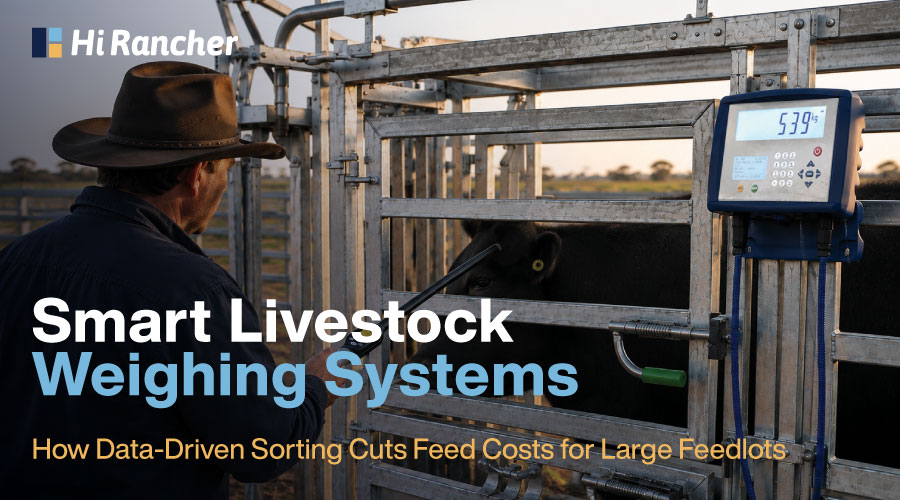
Smart Livestock Weighing Systems: How Data-Driven Sorting Cuts Feed Costs for Large Feedlots
Feed is often the largest production cost in beef finishing operations. In growing and finishing enterprises, feed and grazing expenses can account for a substantial share of total production costs, which makes small improvements in growth monitoring and management timing financially meaningful at scale.
For a large feedlot, however, reducing feed cost does not simply mean feeding less.
The real challenge is identifying:
- cattle that are gaining below expectations,
- groups that are responding differently to the same feeding program,
- animals approaching target weight,
- and cattle that may be accumulating additional days on feed without the expected return.
This is where a smart livestock weighing system becomes useful.
It does not calculate feed efficiency on its own and cannot replace feed-intake data. Instead, it creates a more reliable stream of weight information that managers can combine with ration, intake, health and cost data to make faster decisions.
Why Weight Gain Matters When Feed Is the Largest Cost
Feed cost becomes inefficient when additional feeding days do not produce the expected liveweight gain.
Consider two groups receiving similar feeding inputs.
If one group progresses toward target weight as expected while another begins to fall behind, continuing to manage both groups in exactly the same way can hide a performance problem.
The difficulty is detecting that difference early enough.
Visual assessment is useful, but it cannot consistently identify relatively small changes in liveweight across hundreds or thousands of animals.
Regular weighing adds an objective measure.
Instead of asking:
“Do these cattle look like they are performing well?”
management can ask:
“Are these cattle gaining at the rate we expected since the last weighing?”
That change from visual estimation to measurable performance is one of the main reasons weighing data becomes increasingly valuable as herd size grows.
A Single Weight Is Less Valuable Than a Weight Trend
Knowing that an animal weighs 610 kg is useful.
Knowing that the same animal moved from:
562 kg → 587 kg → 610 kg
is much more useful.
Repeated measurements create a growth history that can help reveal:
- whether an animal is progressing normally,
- whether weight gain is slowing,
- whether a management group is diverging from another group,
- and whether cattle are approaching a target weight.
This does not automatically tell the manager why performance has changed.
A slowdown could be associated with nutrition, health, environmental conditions, competition, management or other factors.
What weighing does is identify where closer investigation may be needed.
Why Manual Weight Records Become Difficult at Scale
The challenge in a large feedlot is not only obtaining an accurate weight.
It is making sure that:
the correct weight is connected to the correct animal at the correct time.
With manual recording, several problems become increasingly common as throughput rises:
- animal IDs written incorrectly,
- weight assigned to the wrong animal,
- missing dates,
- duplicate entries,
- handwritten records that need to be re-entered,
- and historical weights stored across separate spreadsheets or notebooks.
Each individual error may look small.
Across thousands of weighing events, however, poor record quality makes performance analysis less reliable.
This is where EID-based weighing changes the workflow.
How an EID-Enabled Weighing Workflow Works
A modern livestock weighing workflow can be simplified as:
EID Tag
↓
EID Reader identifies the animal
↓
Animal enters the weighing platform or cattle crush
↓
Load Cells / Load Bars measure the live load
↓
Weighing Indicator stabilizes and records the weight
↓
Animal ID + Weight + Date are linked
↓
Records are stored or exported for analysis
The important improvement is not simply that the equipment is digital.
It is that identification and weighing become part of the same data-capture process.
This reduces the need to manually match animal IDs with weights after cattle have passed through the handling system.
How Better Weight Data Supports Feedlot Sorting
One of the practical uses of repeated weight data is sorting.
Large cattle groups rarely develop at exactly the same rate.
When current weights and previous records are available, managers can identify differences that may justify:
- regrouping,
- another health check,
- ration review,
- closer monitoring,
- or preparation for sale.
For example, cattle progressing quickly toward a target market weight may require a different decision from animals in the same original group that are gaining more slowly.
Without current weight data, both groups can remain under the same management plan longer than necessary.
The financial benefit therefore comes from creating a shorter feedback loop:
Weigh → Compare → Identify Exceptions → Review → Act → Reweigh
The faster a meaningful performance difference is detected, the sooner management can investigate it.
Weight Data Is Only One Part of Feed Efficiency
This distinction is important.
A livestock weighing system cannot independently calculate true feed conversion unless feed intake is also measured.
Evaluating feed efficiency normally requires data such as:
- feed intake,
- liveweight gain,
- average daily gain,
- ration cost,
- health status,
- and feeding period.
Weight data provides the growth side of that equation.
This makes regular weighing especially useful when it is combined with feed-management records rather than treated as an isolated measurement.
For example, if a ration changes and subsequent weighing shows a different growth response, managers have another objective data point to include in the evaluation.
What Makes a Weighing System Practical for a Large Feedlot?
More data is not automatically better.
A weighing system has to collect useful information without becoming a bottleneck in cattle handling.
Four areas matter particularly in larger operations.
1. Stable Weight Capture
Cattle move.
Unlike weighing static industrial products, livestock scales need to produce useful readings while an animal shifts its weight on the platform.
If operators spend excessive time trying to obtain a stable reading, weighing quickly interferes with normal cattle flow.
2. Reliable Animal Identification
Where performance is tracked individually, the system needs a practical way to link an animal with its weight.
EID reduces dependence on manual ID entry and becomes increasingly valuable as weighing volume increases.
3. Data That Can Leave the Indicator
Stored information should be usable outside the weighing point.
Depending on the operation, this may involve:
- USB export,
- Bluetooth transfer,
- serial communication,
- CSV records,
- or integration into an existing farm data workflow.
The best communication method is the one that fits the farm’s existing process.
4. Hardware Designed for the Installation
An accurate indicator cannot compensate for load bars that are poorly matched to the weighing structure.
Capacity should account for:
Animal Weight + Platform / Crush Weight + Working Safety Margin
This becomes particularly important with large steel or hydraulic cattle crushes.
Why Outdoor Hardware Matters to Data Quality
A feedlot weighing station may operate around:
- mud,
- rain,
- manure,
- washdown,
- dust,
- livestock impact,
- cable movement,
- and repeated loading.
If weighing hardware becomes unreliable in these conditions, the problem is larger than the cost of repairing a component.
The operation may also lose scheduled weight records.
This creates gaps in the performance history that the system was installed to collect.
For outdoor weighing, livestock load bars therefore need to be evaluated for their construction as well as nominal weighing capacity.
For example, HiRancher’s ABT livestock load bars use a sealed tubular housing with a hot-dip galvanized finish. The internal load cells are rated IP66, and the cables use stainless-steel spring protection to reduce exposure to physical damage.
For heavier cattle handling structures, the AB5T provides a 5,000 kg rated capacity, 1100 mm bar length and reinforced base structure.
These specifications illustrate an important selection principle:
Choose load bars for the total weighing structure and operating environment—not simply for the weight of the cattle.
Where the Weighing Indicator Fits into the Process
Once a reliable weight is captured, the indicator determines what can be done with that information.
A basic indicator may only need to display and record weight.
More data-intensive feedlot operations may also need:
- EID identification,
- individual animal records,
- historical weight information,
- grouping,
- and data export.
For example, HiRancher’s FOX PRO is designed to combine livestock weighing with EID-based identification and supports USB, Bluetooth and RS232 communication.
The important point is not that one indicator has more features than another.
The question is:
Does the weighing system capture the information required for the management decision?
Operations evaluating this type of workflow can explore HiRancher’s heavy-duty feedlot load bars and EID weighing indicators.
Where Cost Control Can Actually Occur
A smart weighing system does not create feed savings simply by being installed.
The potential savings come from the decisions made with better information.
Identify Poor Performance Earlier
Repeated weights can flag animals or groups whose growth pattern has changed.
This gives managers a reason to investigate earlier instead of waiting for a visible difference to appear.
Reduce Unnecessary Days on Feed
More current weights provide better information about which animals are approaching production or market targets.
Improve Sorting Decisions
Instead of relying only on age, arrival group or visual estimation, cattle can also be reviewed using measured performance.
Reduce Manual Data Handling
EID-linked weighing reduces repeated transcription between animals, paper records and digital files.
Make Feeding Reviews More Evidence-Based
Weight trends can be considered alongside feed intake, ration changes, health records and cost information.
None of these benefits comes from the scale alone.
They come from shortening the distance between:
measurement → recognition → management action.
Questions to Ask Before Installing a Smart Weighing System
Before comparing indicator models or load bar capacities, a feedlot should define the management workflow first.
Ask:
- How often will cattle realistically be weighed?
- Are decisions made at animal level or group level?
- Is individual EID identification required?
- How many cattle must pass through the weighing point during each session?
- Will the scale sit beneath a platform, mechanical crush or hydraulic cattle crush?
- What is the combined weight of the cattle and weighing structure?
- Is the equipment permanently exposed to rain, mud or washdown?
- Where should the data go after weighing?
- Who will review the weight records?
- Which management decision will change when a performance exception is found?
These questions are more important than simply choosing the weighing system with the longest feature list.
The Goal Is a Faster Management Feedback Loop
For a large feedlot, feed cost control usually comes from many small operational decisions rather than one dramatic change.
Better livestock weight data can help managers:
- detect performance changes earlier,
- compare groups more consistently,
- investigate poor growth sooner,
- improve sorting decisions,
- and make market timing decisions using more current information.
A smart livestock weighing system provides the measurement infrastructure behind that process.
The hardware still matters. Load bars must suit the physical environment, and the indicator must collect the type of data the operation actually needs.
But the real objective is not to install more technology.
It is to create a reliable cycle of:
Measure → Compare → Decide → Act → Measure Again
For feedlots planning this type of workflow, explore HiRancher’s heavy-duty livestock weighing systems with EID indicators and feedlot load bars to understand how the weighing hardware can be configured around different cattle handling environments.