



How Livestock Traceability Systems Improve Farm Efficiency and Compliance
Introduction
As livestock operations grow in scale and complexity, managing animals manually becomes increasingly inefficient.
Errors in identification, missing records, and inconsistent data can lead to poor decision-making and compliance risks.
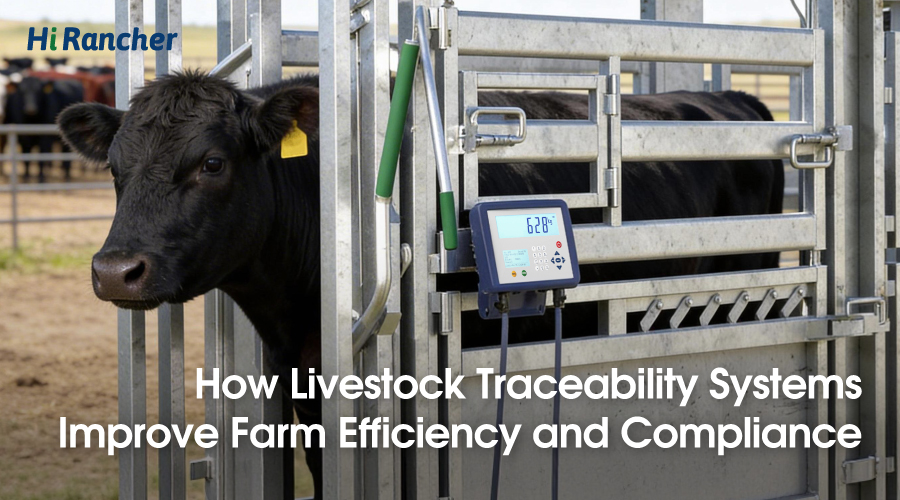
This is why more farms, integrators, and livestock service providers are adopting a livestock traceability system — a solution that combines weighing, identification, and data management into a single workflow.
By enabling accurate animal tracking and structured livestock data management, these systems are transforming how modern farms operate.
What Is a Livestock Traceability System?
A livestock traceability system is designed to capture, link, and manage key animal data throughout its lifecycle.
It typically integrates:
- Livestock weighing indicators
- Load bars or weigh beams
- EID (electronic identification) ear tags
- EID readers
- Data storage and export functions
▶ Together, these components form a complete animal tracking system, where each animal’s identity and performance data are automatically recorded.
From Manual Records to Automated Data Collection
Many farms still rely on manual processes:
- Writing down animal IDs
- Recording weight separately
- Transferring data later into spreadsheets
This approach often leads to:
- Data entry errors
- Missing or inconsistent records
- Increased labor costs
- Limited ability to analyze performance
The Automated Alternative
A modern livestock traceability system replaces manual steps with automation:
- Animal enters weighing area
- Load bars measure weight
- EID reader identifies the animal
- System links ID + weight instantly
- Data is stored for future use
▶ An integrated system reduces errors and improves operational efficiency.
Improving Farm Efficiency Through Data
Accurate and consistent data is the foundation of efficient livestock management.
With a livestock data management system, farms can:
- Track weight gain per animal over time
- Monitor feed conversion efficiency
- Identify slow-growing or unhealthy animals early
- Reduce time spent on manual record-keeping
▶ Instead of reactive management, farms can make proactive, data-driven decisions.
Supporting Compliance and Traceability Requirements
Traceability is becoming increasingly important in the livestock industry, especially for:
- Export markets
- Government regulations
- Health and inspection standards
A livestock traceability system helps ensure:
- Each animal is uniquely identified
- Weight and history records are accurately stored
- Data is available for audits and certification
Key Compliance Benefits
- Reliable documentation for export processes
- Accurate health and inspection records
- Audit-ready traceability data
▶ This is particularly critical for farms supplying regulated markets.
Real-World Applications
Commercial Farms
- Daily weighing and performance tracking
- Herd management and optimization
Feedlots
- Monitoring growth rates
- Improving feeding efficiency
Livestock Markets & Auctions
- Fast identification and weighing
- Reduced handling time and stress
Veterinary & Inspection Services
- Health checks and compliance verification
- Accurate animal identification
Breeding & Research Programs
- Data collection for genetic selection
- Performance-based breeding decisions
Why Integrated Systems Deliver Better Results
Some buyers attempt to combine separate components from different sources.
However, this often results in:
- Compatibility issues
- Data inconsistency
- Complex installation
An integrated livestock traceability system offers:
- Verified compatibility between components
- Stable and accurate data collection
- Simplified operation and maintenance
▶ This leads to more reliable performance and lower long-term costs.
Choosing the Right Livestock Traceability System
When selecting a system, buyers should consider:
- Compatibility with load bars and weighing structures
- Support for EID identification (HDX / FDX-B)
- Data storage and export capabilities
- Suitability for outdoor farm environments
- Scalability for future expansion
▶ A well-matched system ensures both immediate usability and long-term value.
Conclusion
A livestock traceability system is no longer optional for modern farms.
It is a critical tool for improving efficiency, ensuring compliance, and enabling data-driven livestock management.
By integrating weighing, identification, and data recording into a single process, farms can:
- Reduce manual work
- Improve data accuracy
- Meet regulatory requirements
- Enhance overall operational performance
Build Your Livestock Traceability System
If you are planning to upgrade from manual processes to an automated solution, selecting the right system configuration is essential.
You can share:
- Animal type (cattle, sheep, pigs)
- Farm size and workflow
- Existing equipment
- Traceability or export requirements
▶ Get a complete livestock traceability system tailored to your operation
▶ Check compatibility with your current setup
▶ Request system configuration and pricing