



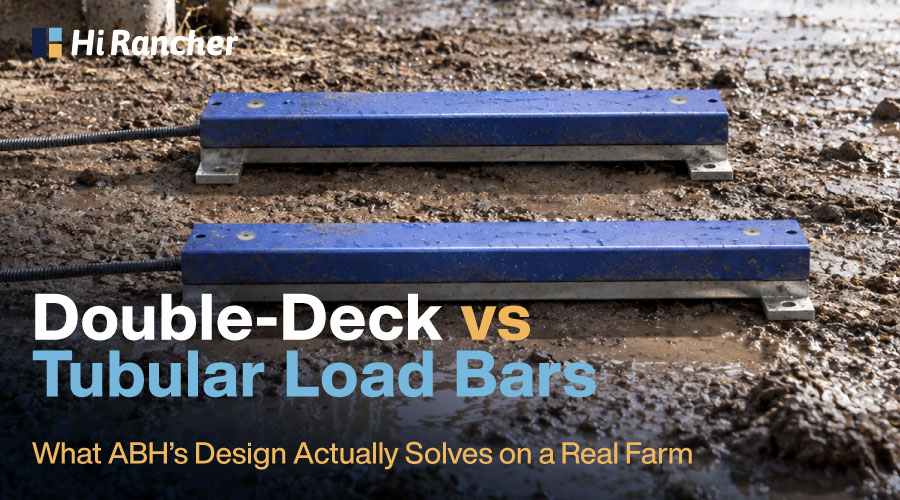
Double-Deck vs Tubular Load Bars: What ABH’s Design Actually Solves on a Real Farm
Livestock load bars may look simple, but the forces they handle on a working farm are anything but.
Two weigh beams sit beneath a platform, alleyway or cattle crush, an animal steps onto the system, and the indicator displays a weight. In practice, however, cattle rarely apply that weight evenly or calmly. They shift, lunge, lean against crush walls, kick, and step onto platforms off-center.
That means a livestock weigh beam does far more than support static weight. It must tolerate off-center impacts, side loads, repeated loading cycles, and constant animal movement without allowing excessive deflection or instability.
While double-deck, enclosed tubular, and heavy-duty reinforced load bars all measure livestock weight, they are engineered for different mechanical stresses and environmental hazards. Selecting the right system is not simply about maximum capacity; it is about matching the hardware to the conditions it will face every day.
Why Livestock Loads Are Mechanically Different
Industrial weighing often involves objects that are placed slowly and evenly on a scale.
Livestock weighing is much less controlled.
A steer may step onto one end of the platform first, shift its body weight from side to side, push against a gate, or lean heavily against the wall of a crush. Sheep and pigs also move continuously while being weighed, especially when they are entering or leaving a handling system.
These movements introduce more than vertical load. They can create:
- Off-center loading
- Side forces
- Short impact loads
- Repeated load cycles
- Platform movement
- Uneven force distribution
Rather than simply “holding the animal,” a well-designed livestock load bar provides a rigid and continuous load path that helps stabilize these changing forces for consistent measurement.
What a Double-Deck Load Bar Solves
The term double-deck refers to the mechanical layout of the weigh beam rather than a different weighing technology.
In HiRancher’s ABH design, the internal load cells are supported within a double-deck steel frame. This configuration is useful in livestock applications because it improves the mechanical stability of the weighing assembly under repeated and uneven loading.
On a real farm, that helps with two common challenges.
Better Stability Under Uneven Loading
Cattle rarely distribute their body weight evenly across a platform.
When an animal enters a crush or alleyway, most of the load may initially fall toward one end or one side. A rigid double-deck frame helps the weighing system remain mechanically stable while those forces shift.
This is particularly useful beneath:
- Cattle crushes
- Alleyway scales
- Livestock platforms
- Weighing crates
- Portable farm scales
The objective is not to eliminate animal movement. It is to reduce the effect that uneven loading has on the weighing structure itself.
Greater Protection During Repeated Livestock Handling
Farm weighing equipment is exposed to repeated impacts that are uncommon in many static industrial applications.
Animals step heavily onto the platform, push against surrounding steelwork, kick, and shift position during weighing. During busy handling sessions, the same system may be loaded hundreds of times.
ABH’s double-deck frame gives the internal weighing components a more rigid mechanical foundation under these repeated loads.
The advantage is not simply that “two layers are stronger than one.” The design is better understood as a way to handle the dynamic, uneven loading that occurs during livestock movement.
Why Side Loads Need Attention
Load cells perform best when force travels through the intended load path.
Livestock rarely create ideal loading conditions.
A steer leaning against a cattle crush or entering the weighing area at an angle can introduce horizontal and off-center forces. If the supporting frame flexes excessively, twists, or contacts nearby steelwork, part of the load may no longer travel cleanly through the load cells.
That can lead to inconsistent readings even when the electronic components themselves are functioning correctly.
For this reason, livestock weigh beams often rely on:
- Rigid mounting
- Stable support points
- Adequate structural clearance
- Reinforced housings
- Protection against side loading
Mechanical installation is therefore just as important as load cell accuracy.
Accurate Weighing Does Not Require a Completely Still Animal
It is unrealistic to expect cattle to stand perfectly still.
A practical livestock weighing system instead combines a stable mechanical base with an indicator capable of processing a changing signal.
The load bars provide the physical measurement foundation. The indicator interprets that signal and determines how the final weight is displayed, recorded, or exported.
This distinction is important because the load bars and the indicator solve different parts of the weighing task.
The load bars are selected primarily for:
- Capacidad
- Mechanical design
- Instalación
- Environmental conditions
The indicator is selected primarily for:
- Weight display
- Record keeping
- EID
- Connectivity
- Data management
Where Double-Deck Design Stops Being the Main Priority
A strong mechanical frame is valuable, but it does not solve every farm requirement.
Once a weighing system moves from a covered barn into an exposed cattle yard, environmental wear can become the larger concern.
Continuous rain, mud, manure, urine, high humidity, and regular washdown introduce a different set of risks. Corrosion resistance and protection from contamination may become more important than the mechanical benefits of a double-deck layout.
This is where the distinction between ABH and ABT becomes clearer.
They should not be viewed as “standard versus premium” versions of the same product. They are better understood as different designs for different operating conditions.
ABH: Built Around Mechanical Stability
ABH uses a double-deck frame with a powder-coated carbon-steel housing.
Its design is well suited to livestock operations where repeated animal movement, uneven loading, and general farm handling are the main demands.
Typical installations include:
- Covered cattle yards
- Livestock platforms
- Alleyway scales
- Cattle crushes
- Sheep and pig weighing systems
- Portable weighing setups
ABH also uses protected cabling for farm environments, but its main advantage lies in the mechanical stability of the double-deck frame.
For a covered or relatively controlled location, that may be exactly what the installation needs.
ABT: Designed for Long-Term Outdoor Exposure
Outdoor cattle yards create a different operating challenge.
Here, environmental degradation from rain, mud, manure, humidity, and repeated washdown can become the dominant source of wear.
ABT counters that exposure with a fully enclosed tubular frame and a hot-dip galvanized steel housing.
The enclosed design reduces direct contamination around the internal weighing components, while hot-dip galvanizing provides a more robust corrosion-protection strategy for prolonged outdoor use.
ABT is therefore better suited to:
- Uncovered cattle yards
- Wet livestock facilities
- Muddy feedlots
- Permanent outdoor platforms
- High-humidity environments
- Frequent washdown areas
The difference is not that ABH cannot be used outdoors at all. The distinction is one of long-term suitability.
ABH is a practical general-purpose design for relatively controlled environments. ABT is better matched to locations where moisture and corrosion are part of everyday operation.
Double-Deck vs Tubular: Different Designs for Different Risks
The most useful question is not “Which one is stronger?”
It is:
Which operating risk is more important in this installation?
| Farm Requirement | ABH Double-Deck | ABT Enclosed Tubular |
| Animal movement and uneven loading | Strong fit | Suitable |
| Repeated impact during livestock handling | Strong fit | Suitable |
| General platform weighing | Well suited | Well suited |
| Covered cattle crush | Well suited | Well suited |
| Portable farm weighing | Well suited | Possible depending on setup |
| Permanent outdoor installation | Possible depending on exposure | Better suited |
| Frequent rain and mud | Less preferred for prolonged exposure | Better suited |
| High humidity | Less preferred for prolonged exposure | Better suited |
| Frequent washdown | Less preferred | Better suited |
| Corrosion protection | Powder-coated steel | Hot-dip galvanized steel |
| Main design concept | Double-deck frame | Enclosed tubular frame |
ABH is primarily designed around mechanical stability during routine livestock handling.
ABT places greater emphasis on long-term protection against moisture, contamination, and corrosion.
Both still require proper installation, drainage, cable routing, and routine inspection.
Where AB5T Fits into the System
Some weighing installations create another challenge altogether: the structure being weighed is itself very heavy.
A large cattle crush or hydraulic squeeze chute can add substantial dead weight before the animal even enters.
For that reason, load bar capacity should never be selected from animal weight alone.
A more realistic calculation considers:
Animal Weight + Crush or Platform Weight + Working Safety Margin
A 700 kg steer may therefore require a system with considerably more than 700 kg of available weighing capacity once the supporting equipment is included.
AB5T for Heavy Cattle Crushes
HiRancher’s AB5T sits at the heavy-duty end of the livestock weighing range.
It uses a reinforced tubular design with a 5,000 kg rated capacity and a standard length of 1100 mm. Reinforced footing makes it better suited to heavier cattle handling structures where the load imposed by the crush itself becomes a major part of the system design.
Typical applications include:
- Large cattle crushes
- Hydraulic squeeze chutes
- Heavy steel platforms
- Commercial feedlots
- Fixed high-capacity weighing stations
AB5T should not simply be viewed as “a larger ABT.”
The mechanical demands are different. Heavy cattle handling equipment places greater stress on the support points and increases the total working load well beyond the weight of the animal alone.
Three Load Bar Designs, Three Different Selection Priorities
A practical way to choose between ABH, ABT, and AB5T is to focus on the dominant operating demand.
Choose ABH When Mechanical Stability Comes First
ABH is a strong fit for general livestock weighing where repeated movement, uneven loading, and routine handling are the main concerns, especially in covered or relatively controlled environments.
Choose ABT When Environmental Exposure Comes First
ABT is better suited to permanent outdoor installations where rain, mud, humidity, manure, and washdown create ongoing corrosion and contamination risks.
Choose AB5T When the Weighing Structure Is Heavy
AB5T becomes relevant when a large cattle crush, hydraulic chute, or heavy steel platform significantly increases the total load carried by the weighing system.
This approach is more useful than choosing load bars by livestock species alone.
Two cattle farms may need completely different systems if one uses a lightweight covered platform and the other uses a permanent hydraulic crush in an exposed feedlot.
The Indicator Handles a Different Part of the Job
Once the mechanical setup is defined, the next question is what the farm needs to do with the weight data.
This is where the weighing indicator comes in.
HiRancher’s K7, FOX, and FOX PRO can be paired with different load bar configurations depending on the application, provided electrical and connector compatibility is confirmed.
The load bars should be chosen according to the physical installation.
The indicator should be chosen according to the required functions.
K7 for Basic Weighing
K7 is suitable where the main requirement is straightforward livestock weighing with basic record functionality.
It may be paired with ABH, ABT, or another compatible load bar depending on capacity, environment, and installation.
The important point is that the choice of K7 does not automatically determine the load bar design.
FOX for Routine Weight Records
FOX is better suited to farms that weigh animals regularly and want more structured weight records over time.
A covered platform may use FOX with ABH, while a permanent outdoor cattle yard may use the same indicator with ABT.
The data requirement stays the same. The physical environment changes.
FOX PRO for EID and Individual Animal Records
FOX PRO adds EID-based identification and more advanced livestock record handling.
It is useful where farms need to connect:
- Identificación de animales
- Peso
- Weighing history
- External data workflows
A heavy outdoor cattle crush may combine FOX PRO with AB5T, while another operation may pair the same indicator with ABT.
Again, the indicator is selected for the data workflow, while the load bars are selected for the physical weighing conditions.
Do Not Treat Indicator and Load Bar Selection as One Decision
A common mistake is to assume that one indicator belongs with one specific load bar model.
In practice, the two components answer different questions.
First, define the physical weighing environment:
- What is being weighed?
- How heavy is the platform or cattle crush?
- What is the total working load?
- Is the system portable or fixed?
- Is the weighing station covered or outdoors?
- Will the equipment be exposed to rain, mud, or washdown?
- How much animal movement and impact should the system handle?
Then define the data requirement:
- Is basic weight display enough?
- Are routine records required?
- Does the farm use EID?
- Are individual animal histories needed?
- Does data need to be exported?
- Will the system connect with other farm equipment?
This two-stage selection process usually leads to a more suitable configuration than choosing an indicator and load bars as a fixed package.
Operations planning both parts together can explore HiRancher’s livestock weighing systems with indicators and load bars to see how different combinations can be configured.
What Can Cause Unstable Livestock Weights?
When a cattle scale produces inconsistent readings, the indicator or load cell is often blamed first.
In many cases, however, the cause is mechanical.
Common issues include:
- Platform contact with surrounding structures
- Mud or manure beneath the scale
- Loose mounting points
- Excessive frame movement
- Damaged cables
- Insufficient load bar capacity
- Uneven installation
- Structural distortion
A load cell cannot compensate for a platform that is mechanically binding against the ground or surrounding steelwork.
Stable weighing depends on maintaining a clear and predictable load path from the animal through the platform and into the load bars.
Questions to Ask Before Choosing Livestock Load Bars
Before comparing model numbers, define the actual farm conditions.
Mechanical Requirements
- Is the system installed beneath a platform, alleyway, or cattle crush?
- How heavy is the structure?
- How much animal movement should the system tolerate?
- Will cattle enter quickly or create side loads?
- Is the installation fixed or portable?
Environmental Conditions
- Is the weighing station covered?
- Will the equipment remain outdoors permanently?
- Is mud common?
- Is regular washdown required?
- Is the site humid or corrosive?
- Can water drain away from the load bars?
Data Requirements
- Is basic weighing sufficient?
- Are weight histories required?
- Is individual animal identification needed?
- Does the operation already use EID?
- How should records leave the indicator?
These questions usually reveal more about the right system than maximum capacity alone.
Frequently Asked Questions
What is the advantage of a double-deck livestock load bar?
A double-deck design provides a rigid mechanical frame around the internal weighing components. In livestock applications, this is useful where repeated movement, uneven loading, and impact occur beneath platforms, alleyways, and cattle handling equipment.
Is a double-deck load bar more accurate than a tubular load bar?
Not automatically. Accuracy depends on load cell performance, calibration, installation, and mechanical conditions. Double-deck and tubular designs are better viewed as different structural approaches for different operating demands.
What is the difference between ABH and ABT load bars?
ABH uses a double-deck, powder-coated steel frame and is better suited to general livestock weighing in covered or relatively controlled environments. ABT uses an enclosed tubular frame with hot-dip galvanized protection and is better suited to prolonged outdoor, wet, muddy, and corrosive conditions.
When should a feedlot use AB5T?
AB5T is suitable where the weighing structure itself is heavy, such as a large cattle crush or hydraulic squeeze chute. Its 5,000 kg rated capacity and reinforced footing are intended for higher-load cattle handling installations.
Can the same weighing indicator work with different load bars?
Yes, provided electrical and connector compatibility is confirmed. Indicator selection should be based mainly on the required functions, while load bar selection should be based on capacity, installation, and environment.
Do I need FOX PRO with AB5T?
Not necessarily. AB5T handles the mechanical and capacity demands of a heavy weighing structure, while FOX PRO handles EID and animal data requirements. The appropriate indicator depends on what the farm needs to do with the weight data.
Load Bar Design Should Match the Real Farm Requirement
There is no single livestock load bar design that suits every farm.
ABH’s double-deck frame is a practical choice where mechanical stability, repeated animal movement, and uneven loading are the main concerns.
ABT’s enclosed hot-dip galvanized tubular construction is better suited to sites where prolonged rain, mud, humidity, contamination, and washdown create greater environmental risk.
AB5T serves a different role again, providing the higher capacity and reinforced support needed beneath heavy cattle crushes and other substantial handling structures.
The same principle applies to the weighing indicator. K7, FOX, and FOX PRO should be selected according to the farm’s weighing and data requirements rather than being permanently tied to one specific load bar model.
For operations designing a complete setup, explore HiRancher’s livestock weighing systems with load bars and weighing indicators to compare configurations based on both the physical weighing environment and the data the farm needs to collect.