



Outdoor Livestock Load Bars: Weather-Resistant Weighing Systems for Cattle Feedlots
Outdoor livestock weighing is fundamentally different from weighing cattle inside a covered barn.
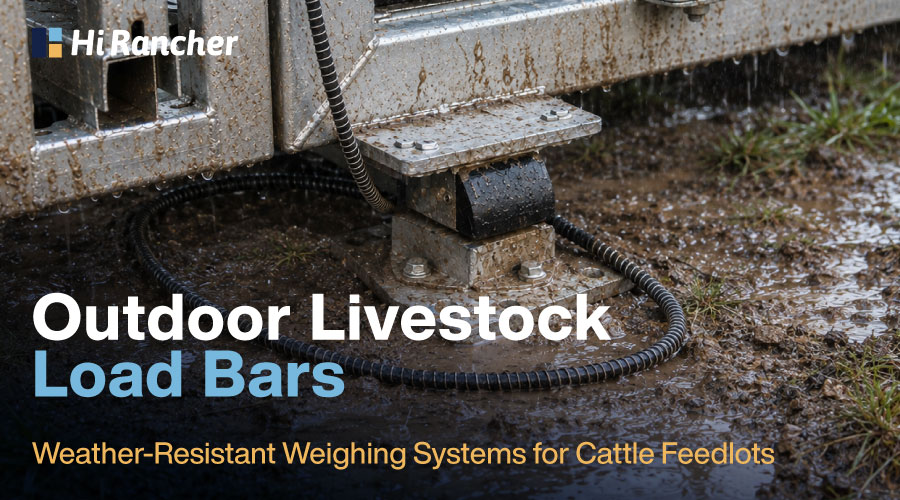
Load bars installed beneath a cattle crush, alleyway scale or platform may be exposed every day to rain, mud, manure, urine, washdown water, dust and changing temperatures. The equipment also sits close to ground level, where moisture and debris tend to accumulate.
For cattle feedlots and outdoor yards, reliable weighing therefore depends on much more than the accuracy of the load cell itself.
A weather-resistant livestock weighing system needs to manage several risks at the same time:
- Water and moisture ingress
- Corrosion of structural steel
- Mud and manure accumulation
- Cable abrasion and animal damage
- Connector exposure
- Poor drainage beneath the weighing structure
- Mechanical binding caused by debris
This is why choosing outdoor livestock load bars should involve more than comparing capacity or IP ratings.
The complete installation matters.
Why Outdoor Feedlots Are Hard on Weighing Equipment
A cattle scale may operate accurately in controlled conditions but face very different stresses after months in an open yard.
Rain and Standing Water
Rain does not automatically damage correctly specified weighing equipment. The greater problem is often what happens after the rain stops.
If the weighing station is installed in a low area or drainage is poor, water can remain around:
- load bar mounting points,
- cable exits,
- connectors,
- platform supports,
- and the underside of the cattle crush.
Repeated wetting increases corrosion risk and keeps electrical connections exposed to moisture for longer periods.
A weather-resistant load bar cannot compensate for an installation that remains permanently surrounded by standing water.
Mud
Mud creates both environmental and mechanical problems.
It holds moisture against steel surfaces and can collect beneath platforms or cattle crushes. As material accumulates, it may eventually contact parts of the structure that are intended to move freely during weighing.
The result may be:
- unstable readings,
- inconsistent zero,
- inaccurate repeat measurements,
- or mechanical binding.
Mud control is therefore part of scale accuracy, not only general yard maintenance.
Manure and Urine
Outdoor livestock equipment is exposed to more than clean water.
Manure and urine can keep surfaces damp and create a more corrosive environment around exposed steel, mounting hardware and electrical connections.
This is one reason corrosion protection becomes more important for permanently installed cattle weighing equipment than for equipment stored indoors after use.
Washdown
Regular cleaning is necessary in many livestock operations, but washing introduces repeated moisture exposure.
A washdown cycle may direct water toward:
- the platform,
- load bars,
- mounting points,
- cables,
- and connectors.
The system therefore needs to handle both contamination and the cleaning process used to remove it.
For outdoor livestock scales, good washdown design should include two elements:
hardware that tolerates the environment + a site that allows water to drain away.
How Outdoor Weighing Systems Commonly Develop Problems
Outdoor weighing problems often develop gradually rather than appearing as a sudden equipment failure.
Repeated exposure to rain, mud, manure and washdown can leave moisture and debris around the weighing structure for long periods. Over time, this may contribute to corrosion, cable damage or mechanical interference beneath the platform.
The first signs are often unstable readings, inconsistent zero or reduced repeatability rather than complete system failure. If these issues are not identified early, animals may need to be reweighed and routine weighing can be interrupted by additional maintenance and downtime.
This is why weather resistance should be treated as a system-level requirement.
Five areas deserve particular attention.
1. Fully Enclosed Load Bar Construction
The physical housing around the weighing components is the first layer of environmental protection.
A more open structure provides more places where mud, manure and water can collect around internal components.
A fully enclosed tubular load bar structure reduces direct exposure of sensitive weighing components to:
- splashing water,
- mud,
- manure,
- dust,
- and debris.
This does not mean the complete weighing system becomes permanently submersible.
Instead, enclosure provides another physical barrier between the internal weighing components and the environment.
For permanently exposed cattle yards, this structural difference can matter more over time than it appears to on a specification sheet.
2. Why Hot-Dip Galvanizing Matters Outdoors
The load bar housing also needs protection from corrosion.
Powder-coated carbon steel can provide practical protection for many general livestock weighing environments. However, permanently exposed feedlots create a more demanding corrosion environment because equipment may remain wet for longer periods and experience repeated contamination and cleaning.
Hot-dip galvanizing creates a zinc coating over the steel surface.
The zinc provides both:
- barrier protection between steel and the environment,
- and sacrificial protection if small areas of the coating are damaged.
For livestock weighing equipment, this makes hot-dip galvanized construction particularly relevant to:
- uncovered cattle yards,
- high-humidity farms,
- wet handling areas,
- muddy feedlots,
- coastal environments,
- and frequent washdown installations.
The important distinction is not that powder coating is unsuitable.
It is that different corrosion-protection systems fit different levels of environmental exposure.
Powder Coating vs Hot-Dip Galvanizing
For a covered weighing station that stays relatively dry, powder-coated steel may provide an appropriate balance of protection, weight and cost.
For equipment expected to remain outdoors for long periods, hot-dip galvanizing provides a more appropriate corrosion-protection strategy.
This distinction becomes useful when comparing general-purpose and outdoor-focused livestock load bars.
3. Cable Protection Is Part of Load Bar Protection
The load cell may be protected inside the housing, but the weighing signal still has to travel through a cable.
That cable can become one of the most vulnerable parts of a livestock weighing system.
Typical feedlot risks include:
- cattle standing on cables,
- abrasion against steel structures,
- gates or crushes pinching cables,
- vehicle traffic,
- rodents,
- cable movement,
- moisture,
- and damage during cleaning.
For outdoor livestock weighing, cable protection should therefore be evaluated alongside the load bar itself.
Useful design features may include:
- durable PUR/PVC cable jackets,
- stainless-steel spring protection,
- reinforced cable exits,
- protected routing,
- and additional conduit where the installation requires it.
Even a mechanically protected cable should not be routed through an area where cattle, gates or vehicles repeatedly contact it.
Cable Routing Matters
A good installation should keep cables:
- away from animal traffic,
- away from moving crush components,
- away from vehicle routes,
- protected from sharp steel edges,
- and away from points where water continually collects.
Hardware protection and installation design need to work together.
4. Do Not Forget the Connector
The connector is another transition point between the load bar and weighing indicator.
A system may have well-protected internal load cells and durable cables, but moisture or physical damage at the connector can still interrupt the weighing signal.
Outdoor installations should consider:
- connector placement,
- correct mating of plugs,
- strain relief,
- exposure to direct washdown,
- protection from animals,
- and whether the connector sits near standing water.
This is also why buyers should be careful when interpreting an IP rating.
An IP rating listed for an internal load cell does not automatically mean:
the housing, cable, connector and complete installed weighing system all carry the same rating.
A more useful purchasing question is:
Which component does the stated IP rating actually apply to?
5. Drainage Is Part of Weather Protection
Drainage is not normally listed as a load bar feature, but it plays a major role in outdoor system reliability.
Consider two identical load bars.
One is installed on a stable, well-drained base where rain and cleaning water flow away quickly.
The other is installed in a depression where muddy water remains beneath the platform after every storm.
The equipment is technically identical.
Its working environment is not.
A good outdoor weighing installation should direct rain and washdown water away from the weighing platform, load bars, mounting points and cable connections instead of allowing water to remain trapped underneath the structure.
Before Installing an Outdoor Livestock Scale, Check:
- Is the base firm and stable?
- Can rainwater drain naturally?
- Where will washdown water flow?
- Can manure build up beneath the crush?
- Are the load bars positioned in a low point?
- Can operators access the underside for cleaning?
- Are connectors positioned where water may collect?
- Is there adequate clearance around the weighing structure?
The principle is simple:
Weather-resistant equipment should support good drainage—not replace it.
Why Mud and Manure Can Affect Weighing Accuracy
Environmental protection is not only about preventing electrical failure.
The platform or cattle crush also needs to transfer weight correctly through the load bars.
If mud, manure, stones or other debris accumulate until they contact the weighing structure, part of the load may be transferred outside the intended load path.
This is known as mechanical binding.
Possible symptoms include:
- difficulty returning to zero,
- unstable readings,
- unexpected variation between repeated measurements,
- and weights that appear consistently high or low.
For this reason, keeping the underside of a livestock platform clean is part of maintaining weighing performance.
After muddy conditions or heavy washdown, operators should check that no debris is creating unwanted contact between the weighing structure and surrounding ground or frame.
What to Inspect After Heavy Rain or Washdown
Outdoor weighing system maintenance does not need to be complicated.
A simple visual inspection can identify many problems early.
Under the Platform or Crush
Check for:
- standing water,
- compacted manure,
- stones,
- mud,
- and debris touching the weighing structure.
Around the Load Bars
Check:
- mounting points,
- abnormal corrosion,
- physical damage,
- and whether the bars remain correctly positioned.
Along the Cable
Look for:
- cuts,
- flattened sections,
- abrasion,
- damaged protective springs,
- stretched cable,
- or sections exposed to vehicle traffic.
Around the Connector
Confirm that:
- plugs remain correctly connected,
- cables are not pulling on the connector,
- the connection is protected from livestock,
- and water is not continually pooling around it.
At the Indicator
Before normal weighing resumes, check that the system:
- returns to zero correctly,
- provides stable readings,
- and responds consistently when a known load is applied where appropriate.
Preventive checks are usually easier than diagnosing intermittent weighing faults during a busy cattle handling session.
ABH vs ABT: Choosing Load Bars by Environment
Not every livestock scale requires the highest level of environmental protection.
The correct choice depends on where the weighing system will actually operate.
HiRancher’s ABH and ABT livestock load bars provide a useful example of how different construction methods suit different operating environments.
| Specifications & Features | ABH Series | ABT Series |
| Recommended Environment | Covered or relatively dry livestock facilities | Permanent outdoor, wet, muddy and humid installations |
| Housing Construction | Double-deck steel structure | Fully enclosed tubular structure |
| Surface Treatment | Powder-coated carbon steel | Hot-dip galvanized steel |
| Internal Load Cell Protection | IP67 | IP67 |
| Cable | 5 m PUR/PVC | 5 m PUR/PVC |
| Cable Protection | Stainless-steel spring protection | Stainless-steel spring protection |
| Typical Installation | Platforms, alleyways, crates and general livestock weighing | Outdoor platforms, cattle yards and exposed crush installations |
| Main Selection Reason | Practical general-purpose configuration | Better suited to prolonged moisture and corrosive exposure |
Important: the IP ratings above refer to the internal load cells. They should not automatically be interpreted as the environmental rating of every component in the complete installed weighing system.
The main difference between the two designs is therefore not simply an IP number.
It is the complete environmental strategy.
ABH combines a double-deck structure with powder-coated steel and is better positioned for general livestock weighing in covered or relatively controlled environments.
ABT combines an enclosed tubular structure with a hot-dip galvanized housing and is better positioned for permanent outdoor, wet, muddy and more corrosive livestock environments.
When ABH Is the More Practical Choice
ABH is better positioned for general livestock weighing where exposure can be controlled.
Typical installations may include:
- covered barns,
- covered cattle handling areas,
- relatively dry livestock platforms,
- alleyway scales,
- crates,
- and portable systems that are not permanently exposed.
ABH also uses protected cabling, so the distinction should not be interpreted as:
ABH = unprotected
ABT = protected
Instead, the question is how much long-term structural and corrosion protection the installation requires.
If the scale remains mostly covered and relatively dry, the additional corrosion protection of an outdoor-focused structure may not be necessary.
When ABT Is Better Suited to the Environment
The selection changes when the weighing equipment will remain exposed for extended periods.
ABT is better aligned with conditions such as:
- permanent outdoor cattle yards,
- uncovered feedlots,
- frequent rain,
- muddy weighing stations,
- high humidity,
- repeated livestock contamination,
- and regular washdown.
The fully enclosed tubular housing helps reduce direct contamination around internal components, while the hot-dip galvanized finish provides additional corrosion protection for long-term outdoor use.
This does not remove the need for:
- drainage,
- cable protection,
- connector management,
- cleaning,
- and regular inspection.
Weather resistance still depends on the complete installation.
Frequently Asked Questions
What does the IP rating on a livestock load bar actually cover?
An IP rating may apply specifically to the internal load cell rather than every component of the complete weighing installation. Outdoor reliability also depends on the load bar housing, surface treatment, cable protection, connector placement, drainage and installation. Always confirm which component the stated IP rating applies to.
Why is hot-dip galvanizing preferred for permanently exposed feedlot load bars?
Hot-dip galvanizing creates a zinc coating that provides both barrier and sacrificial corrosion protection. This makes it particularly suitable for long-term exposure to rain, humidity, manure and repeated washdown. Powder-coated steel remains a practical option for covered or relatively dry livestock weighing environments.
Are livestock load bars completely waterproof?
Weather-resistant livestock load bars are designed to tolerate demanding farm environments, but terms such as “waterproof” should not be applied to the complete system unless every relevant component has the appropriate verified rating. Load cells, housings, cables, connectors and installation conditions should be evaluated separately.
How do you prevent mechanical binding in an outdoor livestock scale?
Mechanical binding can occur when mud, manure, stones or other debris create contact between the weighing platform and surrounding structure. Maintain adequate clearance, provide effective drainage, keep the underside accessible for cleaning and remove debris after heavy washdown or muddy conditions.
Should I choose ABH or ABT for an outdoor cattle crush?
For a permanently exposed cattle crush in a wet, muddy or high-humidity environment, ABT is generally the better fit because of its enclosed tubular structure and hot-dip galvanized housing. ABH is better positioned for general weighing applications in covered or relatively controlled environments. Final selection should also consider capacity, dimensions and installation conditions.
Does a galvanized load bar eliminate the need for maintenance?
No. Corrosion-resistant construction reduces environmental risk but does not eliminate the need for inspection. Drainage, cable condition, connectors, mounting points and debris beneath the weighing structure should still be checked regularly.
Weather Resistance Is a System, Not a Single Specification
A reliable outdoor livestock weighing station depends on several layers working together.
The load bar structure needs to suit the environment. Structural steel needs appropriate corrosion protection. Load cells need suitable environmental protection, while cables and connectors need to be protected against water and physical damage. Correct mounting, effective drainage and regular cleaning are equally important.
Focusing on only one element—such as IP rating—can leave other weak points overlooked.
For covered or relatively dry livestock weighing, a general-purpose configuration such as ABH may provide the appropriate balance.
For permanent outdoor cattle yards, wet feedlots and frequently washed installations, a hot-dip galvanized enclosed structure such as ABT is better aligned with the environmental conditions.
The objective is not to make livestock weighing equipment indestructible.
It is to reduce avoidable causes of failure so that rain, mud, manure and routine cleaning do not interrupt the collection of reliable livestock weight data.
For feedlots planning a permanent outdoor weighing station, explore HiRancher’s outdoor livestock weighing systems with load bars and weighing indicators to see how load bars, weighing indicators and cattle handling equipment can be configured around different operating environments.