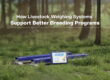




How to Implement RFID Livestock Weighing Systems: A Complete Guide for Cattle Operations
This guide provides ranch managers, feedlot operators, and livestock consultants with practical procedures for implementing RFID-based livestock weighing systems. You will learn equipment selection, installation configuration, data management practices, and system maintenance based on ICAR guidelines and industry best practices.
Understanding RFID Livestock Weighing Fundamentals
RFID livestock weighing systems combine electronic identification (EID) readers with load bars and weighing indicators to automatically capture animal weights linked to individual identification. This integration eliminates manual recording errors and enables real-time performance tracking.
The International Committee for Animal Recording (ICAR) sets global standards for animal identification and performance recording. ICAR-approved EID readers achieve read rates exceeding 99.8% in chute-side applications when properly configured. Each EID tag contains a unique 15-digit number compliant with ISO 11784/11785 standards.
A complete livestock weighing system includes three primary components:
- EID Reader: Captures the unique identification number from RFID ear tags. Readers operate at 134.2 kHz (low frequency) for most cattle applications.
- Load Bars: Measure weight through strain gauge load cells. Typical capacities range from 2,000-5,000 kg per bar.
- Weighing Indicator: Processes signals from load bars and displays weight. Modern indicators include data logging and Bluetooth connectivity.
Selecting Cattle Load Bars
Load bars are the foundation of accurate weighing. Selection criteria include capacity, accuracy, environmental protection, and physical dimensions.
Capacity Sizing:
Calculate required capacity based on maximum animal weight plus safety margin:
- Calves (up to 400 kg): 2,000 kg capacity bars
- Yearlings (400-700 kg): 3,000 kg capacity bars
- Mature cattle (700-1,500 kg): 5,000 kg capacity bars
Apply a safety factor of 1.5-2.0.
Accuracy Requirements:
ICAR specifies minimum accuracy of ±1% for certified livestock scales. Class IIIL indicators achieve ±0.03% of capacity.
Environmental Protection:
- IP67 rating (dust-tight, waterproof to 1m depth)
- Stainless steel or galvanized steel construction
- Hermetically sealed load cells
- Operating temperature range of -20°C to +50°C
Configuring EID Reader System Integration
EID readers connect to weighing indicators through RS-232, RS-485, Bluetooth, or USB interfaces.
Reader Types:
- Panel Readers: Mount alongside the crush or chute. Read range of 20-40 cm. Suitable for high-throughput operations processing 200+ animals per hour.
- Stick Readers: Handheld devices with 5-15 cm read range. Portable and flexible.
Data Protocol Settings:
Configure readers to output tag data in standard format:
- ISO 11784/11785 compliant 15-digit number
- ASCII or binary output format
- Configurable preamble and termination characters
Installing Weighing Systems
Proper installation ensures accurate, repeatable weight measurements.
Site Preparation:
Select a flat, level location for permanent installations:
- Minimum 150 mm thick concrete foundation
- Reinforced with steel mesh
- Cured for minimum 28 days before installation
- Level within ±3 mm across the platform
Load Bar Installation:
- Position load bars at the corners of the weighing platform
- Ensure bars are level and parallel
- Secure mounting bolts to manufacturer specifications (typically 50-70 Nm)
- Connect load bars to indicator using shielded cables
Configuring Weighing Indicators
Calibration:
Perform calibration using certified test weights:
- Zero calibration with empty platform
- Span calibration using weights equal to 50-100% of capacity
- Verify linearity with weights at 25%, 50%, 75%, and 100%
Data Logging Configuration:
Configure the indicator to record:
- EID number
- Weight (kg or lb)
- Date and time stamp
- Session identifier
Managing Weighing Data
Data Export:
Export weighing data in standard formats: CSV, Excel, XML, or proprietary formats for herd management software.
Data Validation:
- Verify unique EID numbers (no duplicates in session)
- Flag weight outliers (>3 standard deviations)
- Check for missing records between entry and exit
Maintaining System Accuracy
Daily Checks:
- Verify indicator powers on and displays zero
- Check for debris under the platform
- Confirm EID reader responds to test tags
Weekly Maintenance:
- Clean load bar terminals and connections
- Check cable condition for damage
- Verify level using a spirit level
Annual Calibration:
- Schedule calibration by certified technician
- Replace worn components (cables, connectors)
- Update firmware to current version
Conclusão
Implementing RFID livestock weighing systems requires careful equipment selection, proper installation, and systematic data management. By following ICAR guidelines and manufacturer recommendations, operations achieve accurate individual animal weights with automatic EID association.