



Livestock Weighing Indicator with EID: Complete Buyer Guide for Modern Farms
As the scale of livestock farming expands, manual identification and weight recording become inefficient and error-prone. This is why more farms are adopting livestock weighing indicators with EID (Electronic Identification) to automate data collection and improve herd management.
Livestock weighing indicator with EID can help farms automatically link animal identification and weight data, thereby reducing labor costs, improving accuracy, and enabling real-time decision-making.
This guide explains how EID integrated weighing systems work, when you need them, and how to choose the right configuration for your operation.
1. What Is a Livestock Weighing Indicator with EID?
A livestock weighing indicator with EID is a device that:
- Receives weight data from load bars (or weigh beams)
- Reads animal ID from electronic ear tags
- Automatically links ID and weight into a single record
It works as the central data unit in a livestock weighing and identification system.
2. How the System Works
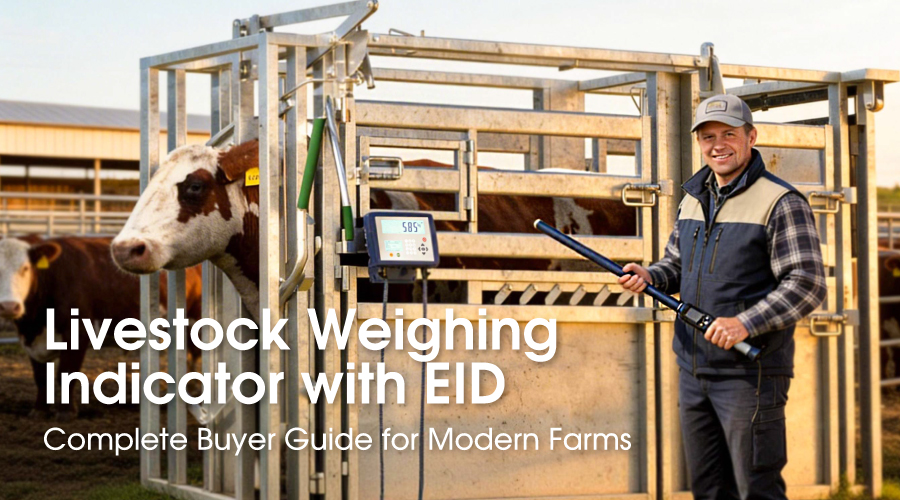
A typical EID weighing system includes:
- Weighing indicator with EID function
- Load bars (or weigh beams)
- Weighing platform / alleyway / cattle crush
- Electronic ear tags (RFID)
Workflow:
- Animal enters weighing area
- Load bars measure weight
- EID reader scans the ear tag
- Indicator automatically records ID and weight
👉 No manual recording required, avoiding data mismatch
3. When Do You Need EID Integration?
EID is not necessary for every farm, but becomes essential when:
Large herd management
- Tracking hundreds or thousands of animals
Performance monitoring
- Recording weight gain over time
Breeding programs
- Managing individual animal data
Traceability requirements
- Government or export compliance
Multi-operator farms
- Reducing human error in data recording
👉 If your farm relies on data, EID is no longer optional.
4. Key Benefits of EID Weighing Systems
Automatic Data Collection
- Eliminates manual recording
- Reduces labor cost
Improved Accuracy
- No ID mismatch
- Consistent data records
Better Decision-Making
- Monitor growth rates
- Optimize feeding strategies
- Track health performance
Scalable System
- Easy to expand across multiple weighing points
5. Choosing the Right Livestock Weighing Indicator with EID
When selecting a system, focus on:
EID Compatibility
- Works with standard RFID ear tags
- Stable reading performance in farm environments
Integration with Load Bars
- Compatible with different load cell systems
- Accurate signal processing
Data Management
- Storage capacity
- Export options (USB, wireless)
- Software integration
Outdoor Durability
- Waterproof and dustproof design
- Stable operation in mud, rain, and dust
6. Common Mistakes to Avoid
- Using incompatible EID tags and readers
- Choosing an indicator without proper outdoor protection
- Ignoring system integration (buying parts separately)
- Underestimating future expansion needs
👉 These mistakes often result in data loss or system inefficiency.
Conclusão
A livestock weighing indicator with EID transforms weighing from a simple task into a data-driven management process.
The right system improves:
- Efficiency
- Accuracy
- Traceability
- Long-term farm productivity
Get a Complete Weighing Solution
If you are planning to implement or upgrade to an EID weighing system, we can help you configure a complete setup:
- Livestock weighing indicator with EID
- Compatible load bars or weigh beams
- EID ear tags and readers
- System integration support
👉 Request a complete EID weighing solution
👉 Check compatibility with your current setup
👉 Get technical recommendations for your farm