



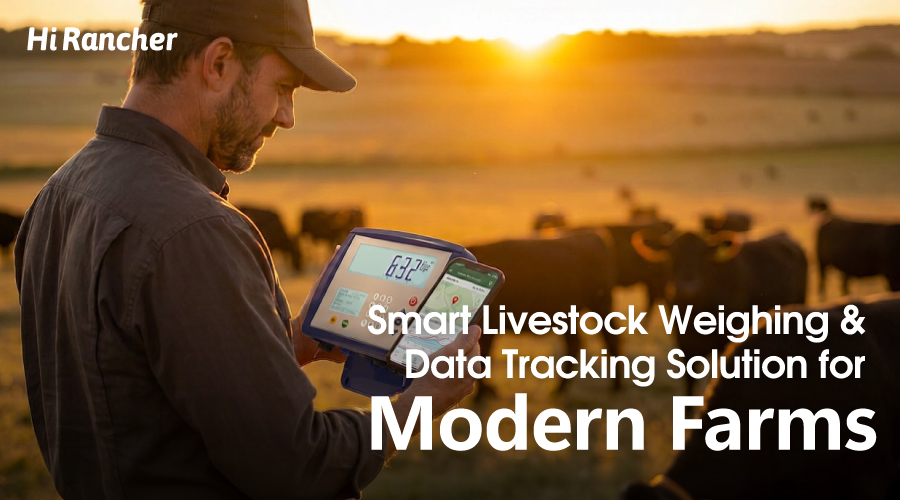
Smart Livestock Weighing & Data Tracking Solution for Modern Farms
Modern farms are moving beyond the scale. Integrated weighing and EID traceability systems are transforming how producers track animals, manage performance, and meet compliance requirements.
For decades, livestock weighing was a simple transaction: move the animal onto the scale, record the number, move on. But as farms scale up and supply chains demand tighter traceability, that approach is no longer enough. A missed tag, a transcription error, or a mismatched record can cost producers time, money, and market access.
That is why integrated livestock weighing and identification systems are rapidly becoming standard equipment on modern commercial farms, feedlots, and livestock markets worldwide.
The Problem with Separate Equipment
Many operations still purchase weighing equipment and animal identification tools separately. On paper, this seems cost-effective. In practice, it creates a fragmented workflow — weights recorded on paper, EID tags logged in a separate system, and reconciliation done manually at the end of the day.
The result: data gaps, higher labor costs, and an audit trail that falls apart under inspection.
An integrated system eliminates that friction entirely. When a scale indicator, load bars, and an EID reader operate as a single unit, every animal that passes through the weigh station exits with a complete, linked data record — ID, weight, date, time, and batch — automatically.
What an Integrated System Looks Like
A complete livestock traceability weighing system brings together four core components:
Scale indicator with EID capability — the control center of the system. It reads the animal’s electronic ear tag, captures the live weight from the platform, and stores the linked record in real time. No manual entry required.
Load bars or weigh beams — precision-engineered for the realities of farm environments: animal movement, outdoor conditions, dust, and moisture. Quality load bars deliver stable, repeatable measurements across cattle, sheep, and pigs.
Electronic identification (EID) system — built around HDX or FDX-B standard ear tags and either handheld or fixed readers. Each animal carries a unique, permanent identifier that travels with it across its entire production lifecycle.
Weighing structures — the physical infrastructure that guides animals through the process safely and efficiently, whether that is a cattle crush with integrated weighing, an alleyway scale system, or a portable platform for remote operations.
Together, these components create a single, automated workflow: animal enters, load bars measure weight, EID reader captures the tag, and the indicator links both records instantly.
From Data Points to Farm Intelligence
The value of an integrated system extends well beyond compliance. When every weighing event is automatically recorded and time-stamped, producers gain a longitudinal view of their herd that was previously only available to operations with dedicated data management teams.
That data can be used to track individual weight gain trajectories, calculate feed conversion efficiency, flag animals that are underperforming relative to cohort benchmarks, and generate the kind of reporting that export markets and government traceability programs now require.
For feedlots, this translates directly into feed cost optimization. For breeding programs, it supports data-driven selection decisions. For veterinary and inspection services, it produces audit-ready records on demand.
Designed for the Realities of Farm Operations
A livestock weighing system is only as good as its reliability in the field. The best integrated systems are built to IP-rated waterproof and dustproof standards, with impact-resistant components designed to withstand the physical demands of working livestock environments.
Equally important is scalability. A system installed on a small family operation today should be capable of expanding — adding more load bars, integrating with farm management software, or connecting to government traceability databases — as the business grows.
Choosing the Right Configuration
No two farm operations are identical. The right system configuration depends on the animal species being handled, the scale of the operation, the existing weighing infrastructure, and the specific traceability requirements of the market or regulatory body being served.
Producers evaluating an upgrade should assess not just the hardware specifications, but the compatibility between components, the quality of technical support available, and whether the supplier can verify performance before shipment.
For distributors and project integrators, the ability to source a fully verified, pre-configured system — rather than assembling components from multiple vendors — significantly reduces installation complexity and long-term support risk.
The Shift Is Already Underway
Government traceability mandates are tightening across major livestock-producing regions. Export certification requirements increasingly demand animal-level data records. And buyers at the premium end of the market are beginning to specify supply chain transparency as a condition of trade.
Farms that invest in integrated weighing and identification infrastructure now are not just improving operational efficiency — they are positioning themselves ahead of requirements that are likely to become universal within the next five to ten years.
The scale is no longer just a scale. It is the entry point to a data system that follows every animal from farm to market.
Interested in configuring a complete livestock traceability weighing system for your operation or distribution network? Share your farm type, animal species, herd size, and traceability requirements to receive a tailored system recommendation and pricing.